The Equinox - and Thoughts About H.G. Wells

by 6:59 PM
The special Sept. 21 Google home page art made me take notice, and though a futuristic writer like H.G. Wells may seem a little out of place on these pages, he remains a staple of Edwardian thought, as well as one of my favorite writers. Surprisingly, it was this photo of him (left) standing in the doorway of this nice, solid-looking English house which caught my notice, and which inspired me to take a little longer look at this writer's world.

For example, I did not know that Wells attended free lectures on socialism at Kelmscott House. I knew he was an early enthusiast of miniature wargames - I have a copy of Little Wars - and I also have the two volume set of his compact Outline of History, which I sadly admit I have not read as yet.

What really surprised me was the fact that after writing the Time Machine in 1895, Wells came to Sandgate in 1896 for the benefit of his health. Enjoying the life there, he commissioned C.F.A. Voysey to build a house in a commanding position overlooking the sea; so it follows that Wells is standing in the doorway of what clearly appears to be a Voysey house. This home (above) known as Spade House, became one of the literary centers of the world in Edwardian times. While living at Spade House, Wells wrote books such as Kipps, Tono-Bungay and Ann Veronica.

One interesting side note - it may be remembered that Voysey usually placed a signature heart motif on the door of every home he designed, but Wells reportedly did not want a heart, so the heart was replaced by a spade motif - thus the name. The house is now utilized as a nursing home.

Taylor Swift an Elizabethan Lady at Madison Square Garden

by 4:18 PM
Okay, so I am not a big Taylor Swift fan -- she's a nice kid, but that kind of pop music's just not my thing. That said, TLG couldn't help but notice the nice outfits she's wearing during her 52-date Fearless tour — which launched in April and wraps in October. Rolling Stone has a full review and some nice photos, including this one of Taylor decked out in some sharp Elizabethan finery.

PHOTO CREDIT: Rolling Stone Online.

As Rolling Stone reports - "for the third act, which kicks off with “Love Story,” dancers dressed in Elizabethan costumes glide across the stage while Swift, wearing a red-and-gold cloak, sings the modern-day Romeo-and-Juliet tale." Seems appropriate. The full story is HERE.

Tudor Lion Statues Come Home to Hampton Court Palace

by 3:54 PM
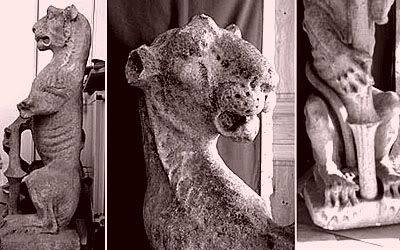
As noted in this interesting Telegraph article we came across, returning two handsome stone beasts to pride of place at Hampton Court Palace seems a fitting way to celebrate the 500th anniversary of Henry VIII's accession in 2009. After sitting in a pub for who-knows-how-long, they were removed in the 1980's during a demolition job, where they were stored in a home until being taken by the owner to a campground in France.

Historians and antiquarians were aware of the statues' existance, and it was discovered that the the lions would have been known as "kyng's beestes" - heraldic animals that once been sprinkled generously around royal residences. Additionally, the pub where they had been originally rescued was on a direct path between two Tudor royal palaces - Hampton Court and the legendary Nonsuch Palace - so the theory that they might well have graced one of the royal palaces seemed to fit.


To celebrate Henry's 500th anniversary year, a new garden in Tudor style was commissioned from historian and garden designer Todd Longstaffe-Gowan. His design for what is now known as the Chapel Court Tudor Garden included a number of hand-carved and painted heraldic beasts standing post among the flowerbeds - traditional ornamentation that would have been familiar in Tudor times. Longstaffe-Gowan was thrilled to have the beasts returned to England as part of the display. He says historians "are agreed that these are early 16th century carving, undoubtedly royal, from which palace we don't know. They're made from Taynton stone - from Oxfordshire - which is very hard and was commonly used by all Henry VIII's stonemasons. They may have been polychromed originally."

To read the entire article and see more photos, go HERE.

Tudor Lion Statues Come Home to Hampton Court Palace

by 3:54 PM
As noted in this interesting Telegraph article we came across, returning two handsome stone beasts to pride of place at Hampton Court Palace seems a fitting way to celebrate the 500th anniversary of Henry VIII's accession in 2009. After sitting in a pub for who-knows-how-long, they were removed in the 1980's during a demolition job, where they were stored in a home until being taken by the owner to a campground in France.

Historians and antiquarians were aware of the statues' existance, and it was discovered that the the lions would have been known as "kyng's beestes" - heraldic animals that once been sprinkled generously around royal residences. Additionally, the pub where they had been originally rescued was on a direct path between two Tudor royal palaces - Hampton Court and the legendary Nonsuch Palace - so the theory that they might well have graced one of the royal palaces seemed to fit.


PHOTO CREDIT: www.telegraph.co.uk.

To celebrate Henry's 500th anniversary year, a new garden in Tudor style was commissioned from historian and garden designer Todd Longstaffe-Gowan. His design for what is now known as the Chapel Court Tudor Garden included a number of hand-carved and painted heraldic beasts standing post among the flowerbeds - traditional ornamentation that would have been familiar in Tudor times. Longstaffe-Gowan was thrilled to have the beasts returned to England as part of the display. He says historians "are agreed that these are early 16th century carving, undoubtedly royal, from which palace we don't know. They're made from Taynton stone - from Oxfordshire - which is very hard and was commonly used by all Henry VIII's stonemasons. They may have been polychromed originally."

To read the entire article and see more photos, go HERE.
Powered by Blogger.